Custom Chocolate Packaging: A Practical Guide for Chocolate Makers
There comes a point when the chocolate is ready for a wider market, but the packaging hasn't caught up. A retailer may want something that can sit comfortably beside established brands. Online orders may arrive looking different from the way they left your premises. Or a packing process that worked for 200 boxes becomes difficult at 2,000.
At that stage, a few questions came up. Which packaging best suits how the chocolate is sold? What information will a retailer need? Which features are worth paying for? How early should you order seasonal packaging?
This guide covers those decisions from a packaging perspective, so you can approach a packaging supplier with a clearer brief and get a more useful quote.
Five Details to Confirm Before Requesting a Quote
Start with these five details:
- How the chocolate will be sold. A bar on a retail shelf needs different packaging from an assortment sold as a gift.
- What goes inside. Provide the dimensions of each piece, the number of pieces per box, and the finished weight.
- How many boxes you expect to need. An approximate range is enough for an initial quote.
- Whether the chocolate is individually wrapped. This determines whether the presentation box will contact the product directly.
- When you need the packaging delivered. This date comes before the retail launch or dispatch date and needs to allow time for packing.
Seasonal projects are particularly sensitive to timing, so a planning calendar appears later in this guide.
Choose Chocolate Packaging Based on How You Sell
Chocolate Bars for Retail and Wholesale
A chocolate bar usually needs a printed sleeve or folding carton that looks good from shelf distance and holds up to regular handling. Printed product cartons ship flat, take up little storage space, and can be finished with foil stamping, embossing, or lamination.
For bean-to-bar makers, the packaging also carries the product story. Plan origin, cacao percentage, producer information, and tasting notes into the layout from the start. Leaving them until the artwork is nearly finished usually results in crowded panels or text that is difficult to read.
Finish matters as well. Matte and soft-touch films look refined, particularly in photographs, but fingerprints may be more visible on dark colors. Gloss lamination is often easier to maintain on products that will be handled repeatedly. The right choice depends on the artwork, sales environment, and desired finish, so it is worth comparing physical samples.
Gift Boxes and Chocolate Assortments
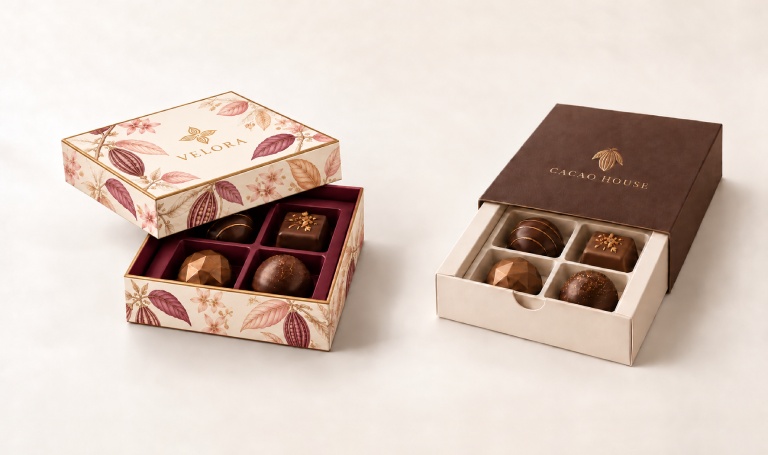
For an assortment, choose the box and tray together. The tray controls the arrangement and is one of the first things the recipient sees when they remove the lid.
Rigid setup boxes work well for premium collections. Their thicker construction supports lift-off lids, ribbon details, magnetic closures, and fitted trays. They also tend to be kept after the chocolate is gone, giving the packaging a longer life.
Rigid boxes cost more and generally take longer to make because they use several components and involve more assembly. Custom rigid boxes are worth the investment for premium products. For larger runs or tighter budgets, a well-printed folding carton with a fitted tray can still look polished at a lower per-box cost.
Ballotin for Truffles and Bonbons
The ballotin is a familiar choice for loose truffles and smaller assortments. It is made from one folded piece, closes without tape, and opens wide enough to present the contents clearly. It is relatively economical and quick to pack, which is why it remains common for counter sales, favors, and products sold by weight.
Packaging for Seasonal Chocolate Collections
Christmas, Valentine's Day and Easter often call for different artwork, formats or product arrangements. Thanksgiving and New Year can also drive host gifts and corporate orders.
The first decision is how much of the pack needs to change. A heart-shaped box or another custom construction requires its own tooling. That investment is easier to justify when you reuse the structure over several seasons. Another option is to keep the same base box and change the sleeve, belly band, or label. This gives each collection a seasonal identity without rebuilding the entire pack.
That approach is particularly useful across Thanksgiving, Christmas and New Year, where one box may support several artwork versions produced within the same period.
Favors, Corporate Gifts and Fundraising Packs
Wedding favors, corporate gifts and fundraising packs often use a small standard format with a name, date or logo that changes from one order to the next. In these cases, a printed product label or hang tag can be more economical than printing a different box for every customer. One base box can then support several occasions or campaigns.
Mailer Boxes for Subscriptions and Online Orders
A printed mailer box combines the shipping container with the unboxing experience, reducing the number of packaging components. This works well for subscriptions and online orders, as long as you also consider internal protection and temperature-control requirements.
The outside of a mailer will carry shipping labels and may show handling marks. If an unmarked gift presentation is important, use a separate retail box inside a corrugated shipper.
|
Box format |
Best suited to |
Relative cost |
Relative lead time |
|---|---|---|---|
|
Bar sleeve or folding carton |
Retail shelves and wholesale |
Lowest |
Shortest |
|
Folding carton with tray |
Mid-range and higher-volume assortments |
Low |
Short |
|
Ballotin |
Truffles by weight and favors |
Low |
Short |
|
Shaped or window box |
Seasonal collections |
Moderate to high |
Longer |
|
Mailer box |
Subscriptions and online orders |
Moderate to high |
Longer |
|
Rigid setup box |
Premium gift collections |
Highest |
Longest |
These comparisons assume similar sizes, quantities, and finishes. The final quote will depend on dimensions, material, quantity, insert, and artwork specifications.
Prepare Your Chocolate Packaging for Retail
Retailers commonly expect a scannable barcode on each unit, enough room for the required product information, and a case quantity that suits their shelf or replenishment system. Some also ask for shelf-ready display boxes that can be opened and placed directly into the display area.
Requirements vary by retailer, so ask the buyer for their packaging and delivery specifications before approving artwork. If wholesale is part of your plan, mention it at the quote stage. It is much easier to reserve space for a barcode and supporting information before the dieline and artwork are final.
What Determines the Cost of Chocolate Packaging?
Four factors usually have the greatest effect on the quote.
Quantity
Printing, finishing, and setup costs are spread across the production run. The price per box therefore tends to fall as the quantity increases, with some of the largest reductions occurring between a small run and the first few thousand units. Ask for more than one quantity so you can compare the savings with the cost of carrying additional stock.
Shape and Size
Larger boxes use more material and take up more space in storage and transit. Custom shapes also require dedicated cutting tools. Reusing the same dimensions across several collections can reduce repeated development costs.
Construction and Assembly
Folding cartons are supplied flat and are generally less expensive to produce and transport. Rigid boxes use more material and require more assembly and shipping volume, which puts them at the higher end of the price range.
Finishes and Additional Components
Foil stamping, embossing, spot UV, specialty paper, windows, trays, and ribbons are separate production elements. Each may be worthwhile, but using several at once can quickly move the quote. One finish used in the right place often has more impact than several competing on the same panel.
Plan Food Labeling Before Finalizing the Artwork
Packaged food sold in the United States may require a statement of identity, net quantity, ingredient list, allergen declaration, nutrition information, and the name and address of the responsible business. The exact requirements and any exemptions depend on the product, business, and sales market.
Chocolate recipes commonly contain major allergens such as milk, soy, peanuts, tree nuts or wheat. Any precautionary wording about possible cross-contact should reflect the manufacturer's documented assessment and current legal guidance; it should not be added automatically simply because equipment is shared.
Confirm the final wording with the appropriate regulatory source or a qualified food-labeling adviser before approving the artwork.
Space is often the practical packaging problem. Small ballotin and bar sleeves may not comfortably hold every required element. A separate product label on the back or base can provide more flexibility. If a recipe, origin, or net weight changes, replacing the label may also be more economical than reprinting the entire box.
Protect Chocolate Packaging During Shipping
Treat the retail box and shipping box as separate components unless the structure has been designed and tested to perform both jobs.
Premium boxes can scuff, dent, or pick up handling labels during parcel delivery. Placing the presentation pack inside a corrugated shipping box helps protect the corners, surfaces, and opening experience. Cushioning should prevent movement without putting pressure on the retail box or the chocolate inside.
Keep the shipper reasonably close to the packed product size. Carriers may charge by dimensional weight when a parcel takes up more space than its actual weight suggests, so unnecessary empty space increases costs on every shipment.
When to Start Seasonal Packaging
Work backward from the date you need the empty packaging delivered, not from the holiday itself. Allow time for artwork, sampling, production, delivery, and packing before you release the product or send it to retailers.
The schedule below is a planning guide, not a fixed production promise. Confirm timing against your chosen construction, quantity, and current production capacity.
Work backward from the date you need the empty packaging delivered, not the holiday itself. Allow enough time for artwork, sampling, production, delivery and packing before releasing the product or sending it to retailers.
The schedule below is a planning guide, not a fixed production promise. Confirm timings based on your chosen construction, order quantity and current production capacity.
|
Seasonal occasion |
Recommended time to start |
Planning consideration |
|---|---|---|
|
Valentine’s Day |
November |
Shaped formats and a short selling window |
|
Easter |
January |
Changing calendar dates and fragile hollow products |
|
Thanksgiving |
August |
Seasonal tray shapes and overlap with year-end production |
|
Christmas and the holiday season |
July to August |
Higher volumes, early retail placement and complex formats such as advent calendars |
|
New Year and corporate gifting |
September |
Logo approvals and competition with Christmas production |
Christmas projects are often delayed because planning begins around the selling month rather than the production schedule. If you need packaging for Thanksgiving, Christmas, and New Year, discuss the three together. They may share dimensions, inserts, or other components, and they will often compete for the same production window.
Chocolate Packaging Mistakes That Cost Time and Money
Ordering Too Late
Late approval can leave only expensive freight options. Begin with the date the empty packaging must reach your packing location and plan backward.
Skipping a Physical Sample
A digital proof can confirm artwork placement, but it cannot show how the box feels, how easily the lid opens, or whether the tray fits the actual chocolate. Test the assembled sample before approving the production run.
Ordering Only on Unit Price
The smallest quantity often has the highest unit cost, but ordering too much seasonal packaging creates obsolete stock. Compare several quantities and consider storage, forecast demand, and whether you can reuse any components.
Starting Artwork Before the Structure Is Final
Barcodes, mandatory information, windows, seals, and tray dimensions all affect the printable area. Finalize the packaging structure and information requirements before completing the artwork.
Ready to Request a Quote?
Send us the five details from the beginning of this guide, along with photographs or samples of the chocolate. We can recommend a box, tray, and label combination based on the product, sales channel, quantity, and budget, then provide a dieline, design support, and quotation.
There is no minimum order quantity, so you can begin with a prototype or short seasonal run before moving to a larger production order. If you are replacing hand-wrapped packaging, let us know which parts of the current process are taking the most time. That will help us recommend a format that is practical to pack and presentable.
Frequently Asked Questions About Chocolate Packaging
What is the best packaging for a chocolate bar?
A printed sleeve or folding carton is a common choice. The primary wrap protects the chocolate, while the outer box carries the branding and product information. Carefully select the finish if the bar will be handled frequently, as fingerprints and scuffing vary with color and lamination.
Can chocolate touch printed paperboard directly?
Only when the complete paperboard, ink, coating, and manufacturing specifications have been confirmed as suitable for the intended food-contact use. Otherwise, place a suitable wrapper, liner, cup, or tray between the chocolate and the printed box.
What is the best box for truffles?
A ballotin works well for loose truffles or products sold by weight. A rigid or folding box with a custom-fitted tray is often better for a fixed assortment sold as a gift. In either case, the insert should prevent movement while letting you remove each piece easily.
Is there a minimum order?
Printingblue has no minimum order quantity. However, unit cost and practical production options change with quantity, construction, and tooling requirements. Ask for pricing at more than one volume before deciding.
Can I use one box across different seasons?
Often, yes. A standard base box can be paired with a different sleeve, band, or label for each occasion. This avoids developing new tooling every season and reduces the risk of being left with obsolete boxes.
Can I order custom packaging in small quantities?
Yes. For very small runs, a custom sleeve or label on a standard box may offer better value than a fully custom structure. Fully customized boxes generally become more economical as quantities increase.
Professional Design & Printing Services
Printingblue offers customized commercial printing solutions to meet your business needs. Our expert team delivers top-notch design and printing services that exceed expectations. Contact us today for a free consultation.